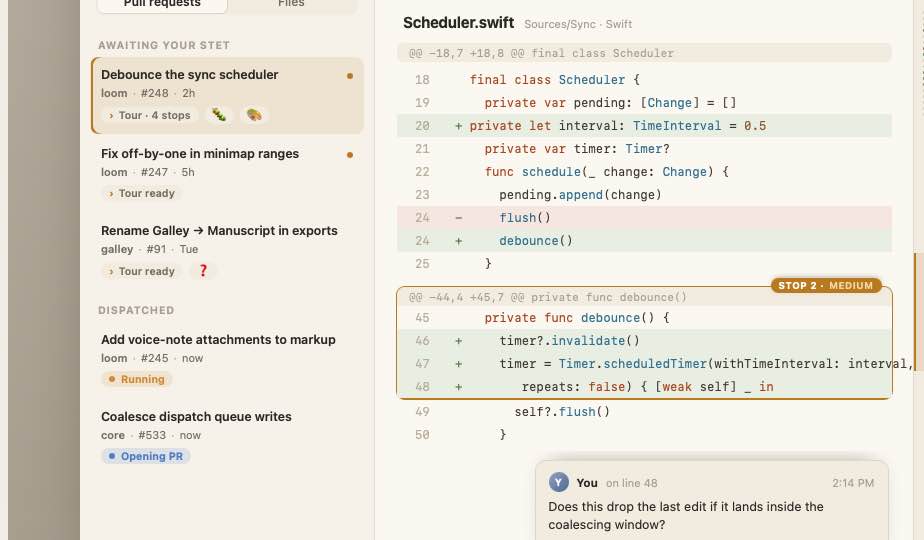
A viewer, not an editor
Read AI-written code and prose. Comment, react, suggest, and vote. The keyboard is for opinions, not code.
Local, sandboxed agents
Submit feedback and a sandboxed agent runs on your Mac — Apple containers or Docker — and opens a pull request.
Bring your own model
Any OpenAI-compatible endpoint. Pluggable harnesses: OpenHands, Crush, Pi. Cloud or a local model.
The project learns
Every dispatch is a versioned trajectory. Distillation turns feedback into reusable skills, committed back to the repo.
Social by design
Comments and reactions ride the forge; a Dolt store versions the rest. Humans and agents vote — humans decide.
A config ecosystem
Agents, Skills, and Verbs versioned across a .stet topology — importable, signed, and governed like software.
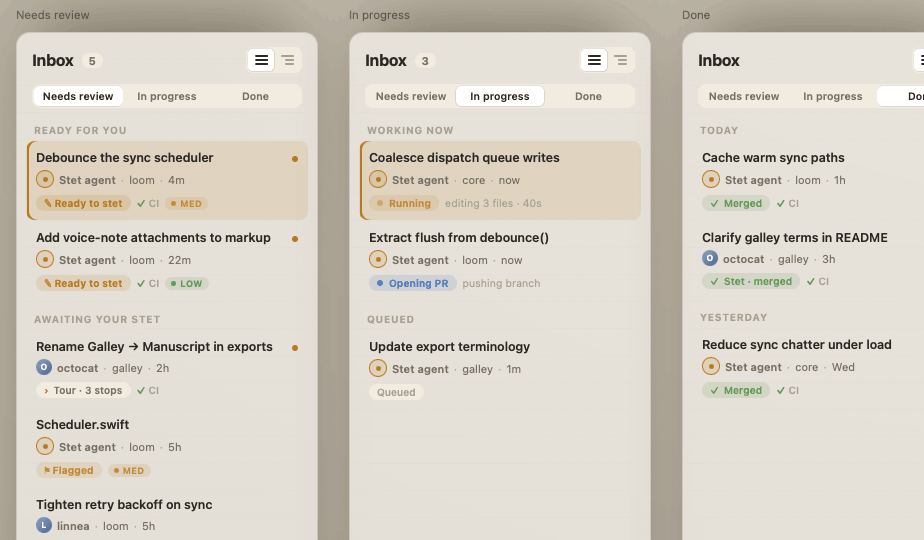
An inbox, not a file tree
Stet opens to what is waiting for your stet — PRs and files grouped by where they are in the loop. Read what an agent wrote, not a directory of everything that exists.
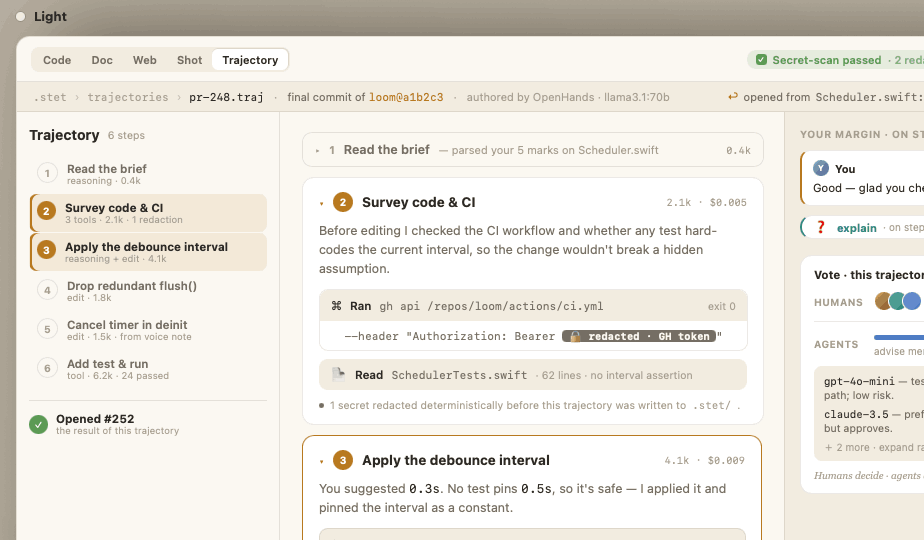
Watch the agent work, then keep the receipt
Submitting a review dispatches a sandboxed local agent that pushes commits to your PR. Every run is captured as a reviewable trajectory — commands, redactions, and cost — committed in-repo like any other artifact.
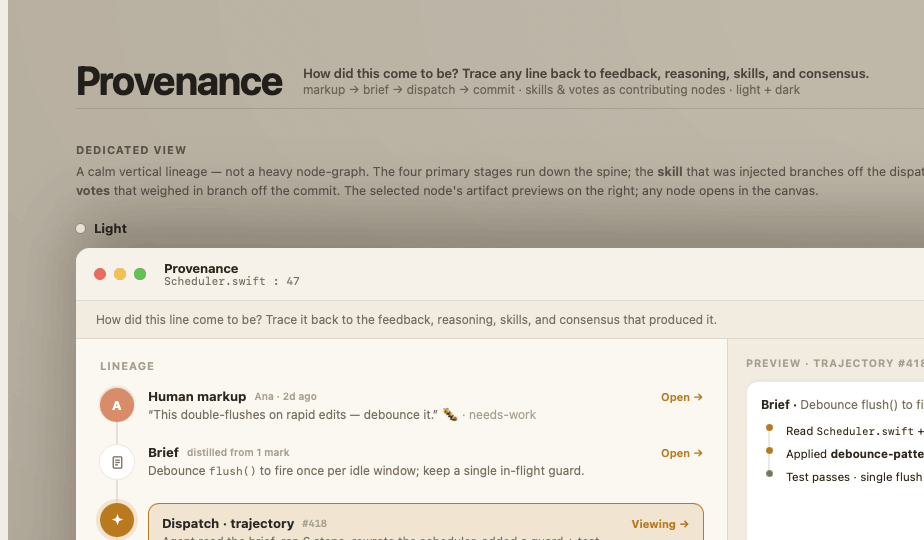
Trace any line back to the feedback that made it
Markup → brief → dispatch → commit, with the skills and votes that weighed in branching off the spine. In a world where the code is written for you, provenance is how you trust it.
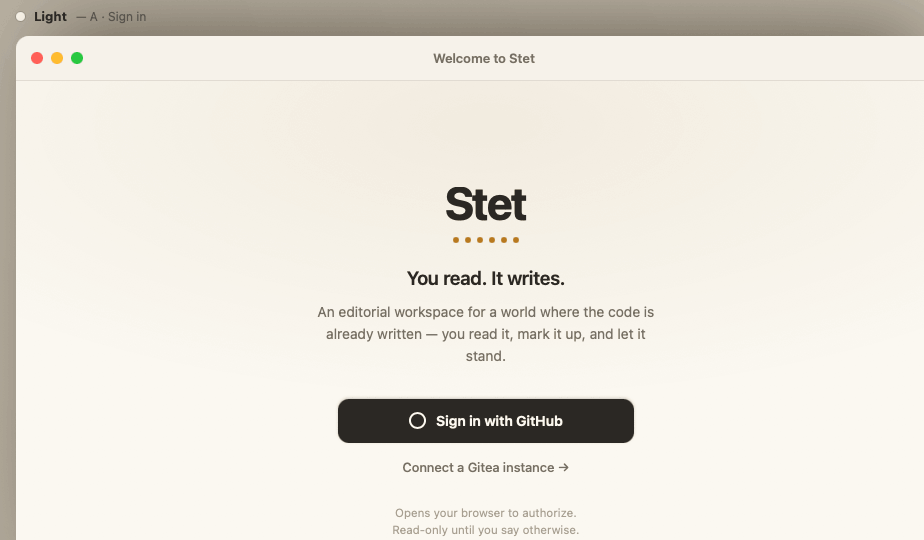
Read-only until you say otherwise
Sign in to GitHub or a Gitea instance, point Stet at your model, and it stays read-only until you dispatch. The wedge is local, sandboxed agents — nothing leaves your machine unless you send it.